
Vertical Nano Ceramic Sand Mill | Musehn Machinery
The UV Ink Challenge: Particle Precision Meets Absolute Purity
In the world of advanced chemical processing, manufacturing premium UV inkjet ink is considered a pinnacle of technical complexity. The requirements imposed on production are exceptionally stringent. Manufacturers must achieve true sub-micron particle distribution—frequently aiming for the D90 < 100nm range—to prevent high-frequency printhead clogging. Concurrently, the milling process must operate with absolute zero metallic contamination.
Traditional dispersion and grinding equipment often fails to meet these twin demands. Standard high-speed mills constructed with hardened steel or metal alloy contact parts experience continuous micro-wear during operation. This attrition introduces trace iron ions and other metal particulates directly into the high-value liquid matrix. For UV inks, this leads to fatal pigment discoloration, chemical instability, and unpredictable curing rates over time.
Understanding these limitations, Musehn Machinery engineered its line of high-efficiency Vertical Nano Ceramic Sand Mills. This specialized equipment is built from the ground up to handle highly abrasive, color-critical, and chemically sensitive fluids such as digital printing inks, conductive pastes, and advanced coatings.
From the Workshop Floor: Field Deployment in Chemical Processing
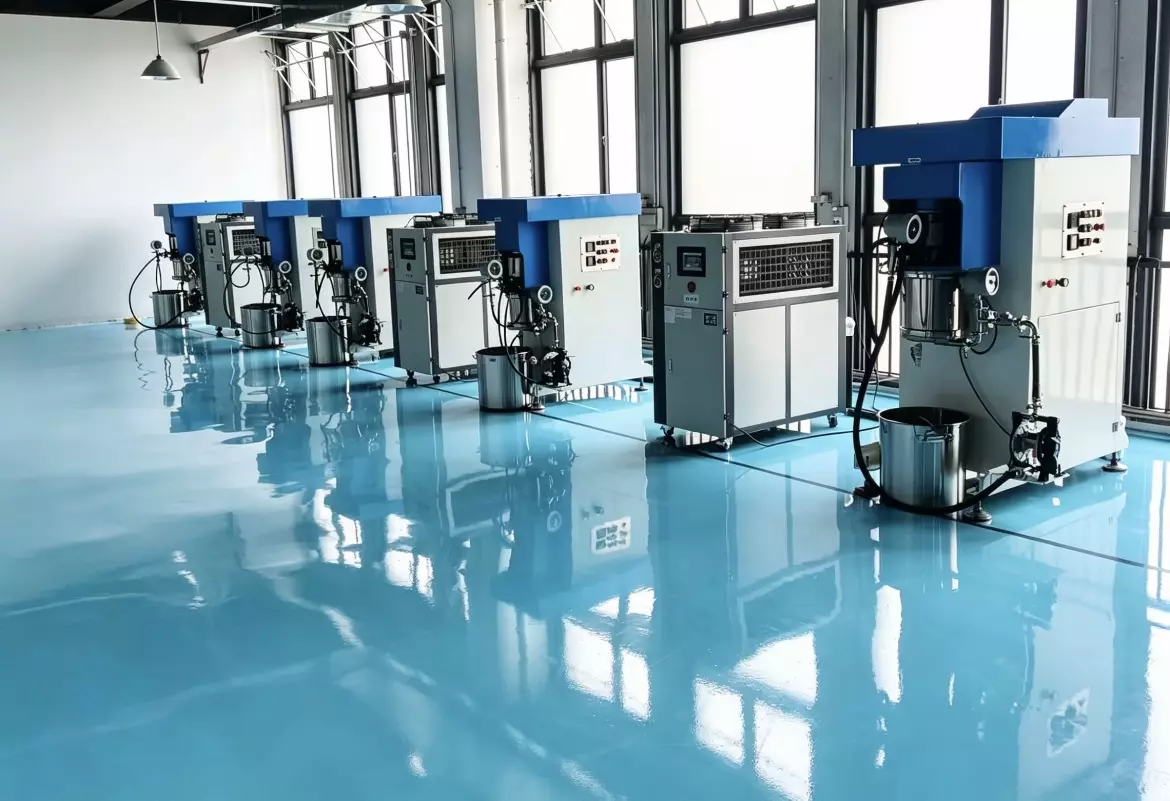
To appreciate the design philosophy of advanced nano-milling, it is best to analyze the equipment within its actual operational environment. The following image captures a typical installation at a premium chemical plant, operating under 24/7 continuous industrial demands.
Operational Architecture: The Advantages of Vertical Layouts for Digital Inks
When choosing equipment for sensitive pigments and monomers, the spatial and physical orientation of the milling chamber plays a critical role. The vertical architecture of Musehn's mills delivers distinct advantages that direct-drive horizontal systems cannot replicate under certain conditions.
1. Gravity-Assisted Processing and Complete Media Segregation
In the production of UV-curable inks, the absolute control of media dynamics is the foundation of consistency. Musehn's vertical design utilizes gravity as a mechanical advantage. The heavy zirconia grinding media and the high-viscosity material naturally distribute toward the high-energy grinding zone at the bottom of the chamber. This eliminates the persistent issue of media compaction or clustering near the discharge screen.
With standard mills, media compression at the separator can restrict output, leading to over-grinding, dangerous pressure spikes, and premature screen wear. The vertical design maintains a stable fluidization pattern. Grinding beads collide continuously within the working zone, while the clean, finely milled ink flows upward through the dynamic screen with zero restriction and no risk of media bypass.
2. Innovative No-Mechanical-Seal Design: Zero Maintenance Costs and Guaranteed Quality
In traditional bead mills, the mechanical seal is the most fragile component, highly prone to wear and tear over time. When a seal fails or degrades due to the friction of high-viscosity materials, it poses a severe risk of fluid leakage, material contamination, and extensive downtime. Furthermore, replacing these complex sealing components incurs heavy maintenance costs.
By leveraging the gravitational advantages of the vertical configuration, Musehn’s engineers developed a groundbreaking No-Mechanical-Seal (NMS) design. This design completely eliminates the risks of slurry or fluid leakage from the source. Because there are no consumable mechanical seals to wear down, the equipment incurs virtually zero subsequent maintenance costs during continuous, heavy-duty industrial operation. This not only saves the operator from continuous replacement expenses but also ensures that every batch of UV ink is processed in a perfectly stable and enclosed environment, offering absolute quality assurance.
3. Full Ceramic Contact Zone for True Purity
To preserve the color brilliance of cyan, magenta, yellow, and deep black pigments, our mills utilize a complete ceramic inner lining combined with solid ceramic agitators. Depending on the chemical nature of the fluid, we incorporate either high-purity silicon carbide (SiC) or specialized zirconia (YSZ) into the chamber walls.
During the entire milling process, the UV ink never makes contact with a single metal surface. This structural choice guarantees zero iron contamination. By keeping the formulation completely free from external metal ions, the ink retains its precise optical properties and maintains strict chemical stability over its shelf life. For manufacturers supplying high-speed digital printing lines, this technical detail reduces the risk of customer claims regarding off-color batches or ruined printheads.
4. Handling High-Viscosity Monomers and Dispersants
The chemical composition of UV-curable inks involves thick polymers, multifunctional monomers, and sensitive photoinitiators. These components create high viscosity during the initial milling stages. Standard disk-type mills often slip through viscous fluids, leading to localized heat spikes, pigment agglomeration, and long processing cycles.
Musehn’s vertical pin-type agitators are engineered with a high torque-to-volume ratio. This geometry delivers intense mechanical force directly to the grinding media, forcing high-frequency micro-collisions within dense bead fields. As a result, the equipment overcomes initial fluid resistance immediately, reducing overall grinding cycles by up to 35% compared to traditional setups. This translates directly to reduced power consumption and higher output per shift.
Engineering Maturity That Translates to Higher Returns
Behind every machine built by Musehn Machinery lies 28years of specialized experience in high-energy dispersion technology. As a Sino-foreign joint venture established in 1998, we combine advanced international engineering principles with precise manufacturing processes.
Every vertical ceramic mill is manufactured under strict ISO9002 quality protocols. We understand that industrial machinery must be both high-performing and highly durable. The integration of our no-mechanical-seal architecture allows us to protect expensive formulations while lowering operational risks for our clients.
When a manufacturer selects Musehn's vertical mills, the investment is not just about a piece of hardware. It is about locking in a reliable production process that delivers:
Tight particle size distribution: Achieving D90 < 100nm consistently across multiple batches without drift.
No mechanical seal maintenance: Complete elimination of leakage risks, saving substantial funds on continuous seal replacements.
Operational savings: Higher grinding efficiency reduces the volume of zirconia beads needed to achieve sub-micron targets.
Previous: How Musehn’s Pin-Type Technology Slashes Production Costs | Musehn Machinery
Next: No More